| Επωνυμία Μάρκας: | HUAKE |
| Αριθμός μοντέλου: | Υ81-315 |
| MOQ: | 1 Σετ |
| τιμή: | 20000-50000 USD |
| Χρόνος Παράδοσης: | 35-40 ημέρες |
| Όροι πληρωμής: | L/C, T/T |
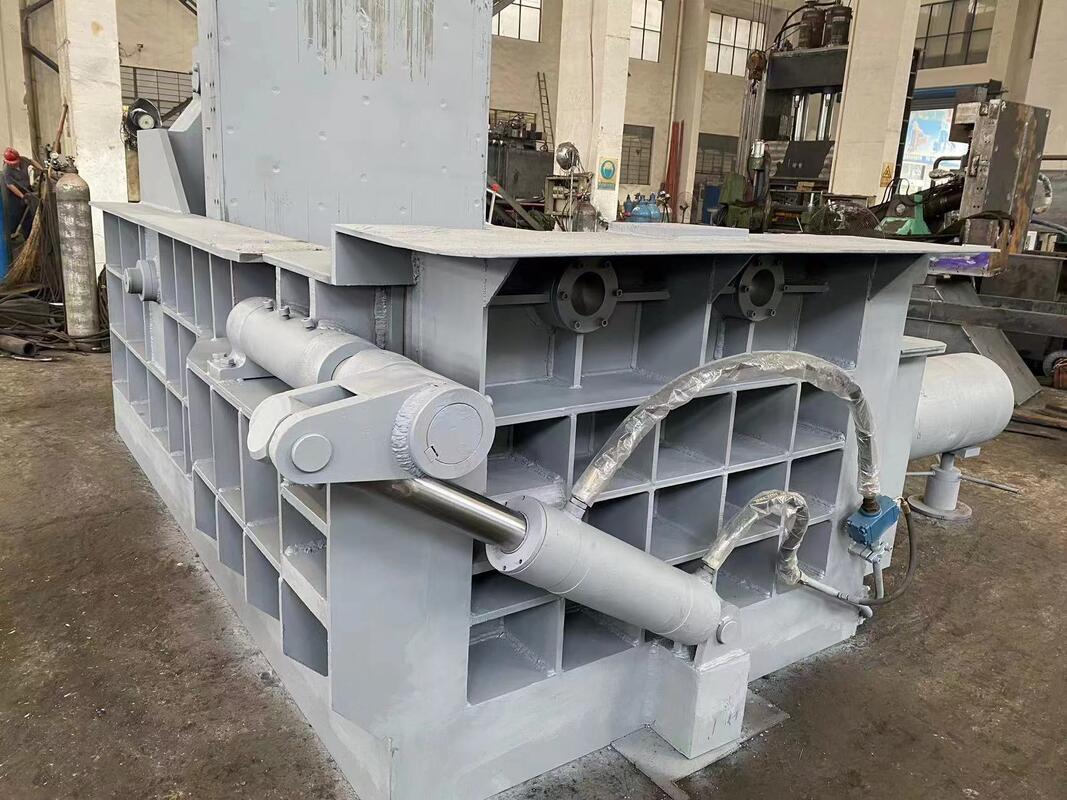
The Y81F-315B is positioned as a 315-ton class hydraulic scrap metal baler for compressing loose metal scrap into dense bales. Its strongest technical anchor is the 3150 kN main cylinder thrust, supported by a full cylinder layout that includes side pressure cylinders, a gate lid cylinder, and a bale discharge door cylinder. This makes the machine suitable for buyers who begin equipment evaluation from compression structure rather than from general product category alone.
The machine also combines a defined material box size, dual-motor drive, dual-pump hydraulic supply, and a published production rate, which gives the page enough measurable depth for technical SEO content.
This version is best suited for steel and metal scrap handling operations that compare balers through force class, chamber size, and cylinder arrangement. The PDF images of pressing and bale turn-out support its use in actual scrap compression workflows.
Because the file is structured as a scrap baler specification sheet, this page works well for keywords around hydraulic scrap metal baler, 315 ton baler, and scrap compression machine.
The main pressure cylinder is the clearest performance-defining component in the document. It is listed at 3150 kN nominal thrust with a 1250 mm stroke.
The PDF includes a gate lid cylinder rated at 1000 kN and a bale discharge door cylinder rated at 550 kN. This helps describe the machine as a complete compression-and-discharge system rather than only a main-force number.
The 2000 × 1750 × 1200 mm material box and 600 × 600 mm bale section provide a defined physical relationship between feed space and output format.
Dual 45 kW motors and dual 31.5 MPa hydraulic pumps support the force-based positioning with actual drive and hydraulic data.
Scrap is placed into the material box and compressed through a multi-cylinder hydraulic sequence. The main cylinder applies the primary force, while the other cylinders support chamber action, lid movement, and bale discharge. The pressing photo on page 4 and the bale turn-out image on page 5 visually match this sequence.
Once formed, the bale exits the chamber through the discharge-side mechanism described in the specification. The published component list allows the process to be explained through actual machine parts, not generic process language.
Choose this model if your main purchasing logic starts with compression class and cylinder structure. The 3150 kN main force, the additional lid and discharge cylinders, and the published chamber size make it easier to evaluate the machine as a force-based industrial baler.
If your priority is only compact shipping or minimal site power, this may not be the first comparison angle. If your focus is force structure and output form, this version is more relevant.
Some operations struggle to compress irregular loose scrap into repeatable bale sections because the machine description they are comparing is too vague. This model solves that by presenting a clearer force structure: 3150 kN main thrust, 1000 kN gate lid cylinder, and 550 kN discharge door cylinder, all tied to one published machine layout.
It also helps reduce ambiguity when comparing different balers because chamber size and bale section are explicitly listed in the source file.
Yes. The main cylinder thrust is listed as 3150 kN, which corresponds to a 315-ton class baler.
The material box dimension is 2000 × 1750 × 1200 mm.
The gate lid cylinder is listed at 1000 kN nominal thrust.
The bale discharge door cylinder is listed at 550 kN nominal thrust.
The bale size is listed as 600 × 600 mm.
The Y81F-315B is positioned as a 315-ton class hydraulic scrap metal baler for compressing loose metal scrap into dense bales. Its strongest technical anchor is the 3150 kN main cylinder thrust, supported by a full cylinder layout that includes side pressure cylinders, a gate lid cylinder, and a bale discharge door cylinder. This makes the machine suitable for buyers who begin equipment evaluation from compression structure rather than from general product category alone.
The machine also combines a defined material box size, dual-motor drive, dual-pump hydraulic supply, and a published production rate, which gives the page enough measurable depth for technical SEO content.
This version is best suited for steel and metal scrap handling operations that compare balers through force class, chamber size, and cylinder arrangement. The PDF images of pressing and bale turn-out support its use in actual scrap compression workflows.
Because the file is structured as a scrap baler specification sheet, this page works well for keywords around hydraulic scrap metal baler, 315 ton baler, and scrap compression machine.
The main pressure cylinder is the clearest performance-defining component in the document. It is listed at 3150 kN nominal thrust with a 1250 mm stroke.
The PDF includes a gate lid cylinder rated at 1000 kN and a bale discharge door cylinder rated at 550 kN. This helps describe the machine as a complete compression-and-discharge system rather than only a main-force number.
The 2000 × 1750 × 1200 mm material box and 600 × 600 mm bale section provide a defined physical relationship between feed space and output format.
Dual 45 kW motors and dual 31.5 MPa hydraulic pumps support the force-based positioning with actual drive and hydraulic data.
Scrap is placed into the material box and compressed through a multi-cylinder hydraulic sequence. The main cylinder applies the primary force, while the other cylinders support chamber action, lid movement, and bale discharge. The pressing photo on page 4 and the bale turn-out image on page 5 visually match this sequence.
Once formed, the bale exits the chamber through the discharge-side mechanism described in the specification. The published component list allows the process to be explained through actual machine parts, not generic process language.
Choose this model if your main purchasing logic starts with compression class and cylinder structure. The 3150 kN main force, the additional lid and discharge cylinders, and the published chamber size make it easier to evaluate the machine as a force-based industrial baler.
If your priority is only compact shipping or minimal site power, this may not be the first comparison angle. If your focus is force structure and output form, this version is more relevant.
Some operations struggle to compress irregular loose scrap into repeatable bale sections because the machine description they are comparing is too vague. This model solves that by presenting a clearer force structure: 3150 kN main thrust, 1000 kN gate lid cylinder, and 550 kN discharge door cylinder, all tied to one published machine layout.
It also helps reduce ambiguity when comparing different balers because chamber size and bale section are explicitly listed in the source file.
Yes. The main cylinder thrust is listed as 3150 kN, which corresponds to a 315-ton class baler.
The material box dimension is 2000 × 1750 × 1200 mm.
The gate lid cylinder is listed at 1000 kN nominal thrust.
The bale discharge door cylinder is listed at 550 kN nominal thrust.
The bale size is listed as 600 × 600 mm.
| Model | Main Cyl.Force (ton) |
Press Box Size (mm) |
Bale Size (mm) |
Bale Weight (kg) |
Motor (kW) |
| Y8F-315A | 315 | 2000x1750x1000 | 500x600 | 300-500 | 2x45 |
| Y81F-315B | 315 | 2500x2000x1200 | 600x600 | 400-700 | 2x45 |
| Y81F-315E | 315 | 2500x2000x1200 | 600x600 | 400-700 | 2x45 |